
Walking into a busy commercial kitchen in Nairobi during the lunch rush, a hotel production kitchen in Mombasa, or a high-volume nyama choma and fast-food restaurant in Nakuru reveals an intense operational environment. Multiple gas burners roar beneath heavy stockpots, deep fryers bubble at 190°C, and charbroilers sear marinated meats. While this high-heat activity drives culinary excellence and business revenue, it simultaneously generates massive volumes of heat, steam, toxic carbon monoxide, and aerosolized cooking oils.
Without an engineered extraction infrastructure, those microscopic grease particles do not simply vanish—they settle onto ceilings, light fixtures, walls, and inside poorly designed exhaust ducts. Over weeks and months, that sticky residue hardens into a highly combustible fuel source. One stray flare-up from a wok or deep fryer is all it takes to ignite an unstoppable ductwork fire capable of destroying a business in minutes.
Investing in a properly engineered Commercial Kitchen Hood and Ventilation Kenya hospitality operators rely on is not merely about keeping chefs comfortable—it is your facility’s primary line of defense against catastrophic smoke damage and grease fires. In this comprehensive guide, we explore the science behind commercial kitchen fires, how integrated hood and extraction systems neutralize those hazards, Kenyan regulatory compliance standards, and best practices for maintenance.
1. The Hidden Anatomy of Commercial Kitchen Grease Fires
To appreciate why commercial ventilation is critical, it helps to understand how a typical restaurant fire starts and spreads. Unlike ordinary paper or wood fires (Class A), commercial kitchen fires primarily involve cooking oils and animal fats (Class K / Class F fires).
Vaporized Grease and Thermal Plumes
When cooking oils are heated above their smoke point, they release a rising plume of hot air, water vapor, combustion gases, and microscopic aerosolized fat droplets. As this thermal plume rises and cools slightly upon hitting ceilings or uninsulated ductwork, the vaporized fats condense back into liquid and semi-solid grease.
The Ductwork Chimney Effect
If grease bypasses inadequate filtration and coats the interior walls of exhaust ducts, the ductwork transforms into a vertical chimney lined with flammable fuel. When a high flame leaps from a grill or a pan boils over on a gas range, the flame is drawn directly into the hood plenum by the suction of the exhaust fan. Once the grease inside the duct ignites, the continuous airflow feeds oxygen to the blaze—creating a blowtorch effect that can rapidly breach ceiling cavities, spread to adjacent rooms, and compromise the structural integrity of the building.
2. Core Components of an Engineered Commercial Ventilation System
A true commercial extraction setup is far more than a metal box with a domestic fan bolted onto the wall. An effective Commercial Kitchen Hood and Ventilation Kenya installation operates as a synchronized, end-to-end engineering ecosystem:
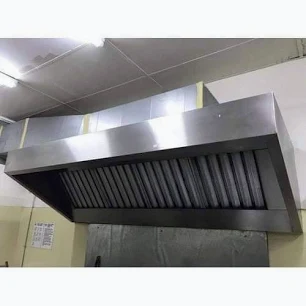
A. Stainless Steel Exhaust Canopy (The Capture Zone)
Positioned directly above the cooking line, the canopy hood acts as an inverted reservoir that captures rising heat, smoke, and grease-laden vapors before they disperse into the kitchen workspace.
-
Material Matters: Commercial canopies are fabricated from heavy-gauge Grade 304 stainless steel. Unlike mild steel or aluminum, stainless steel resists warping under extreme radiant heat, prevents corrosion from acidic cooking vapors and harsh degreasers, and eliminates fire-spreading combustible surfaces.
-
Proper Overhang: To prevent smoke and grease from spilling out around the edges, a commercial hood must overhang the cooking appliances beneath it by at least 150 mm on all open sides—and up to 300 mm over high-heat equipment such as charbroilers, woks, and open-flame grills.
B. Commercial Baffle Grease Filters (The Primary Fire Barrier)
Baffle filters are the single most important fire-prevention component inside the canopy. Unlike domestic mesh filters—which clog quickly with oil and catch fire easily—commercial baffle filters consist of interlocking, curved stainless steel blades.
-
Centrifugal Separation: As hot, grease-laden air is pulled through the narrow S-shaped channels of the baffle filter, the air is forced to change direction rapidly. Because grease droplets are heavier than air, centrifugal force throws them against the cool stainless steel blades, where they condense and drain harmlessly down inclined channels into a removable grease collection tray.
-
Flame Arrestor Function: Because baffle filters contain no flammable mesh and maintain a solid metallic barrier, they act as a physical flame shield—preventing open flames on the stove from entering the ductwork behind the hood.
C. Heavy-Duty Exhaust Ductwork
Once filtered, hot air and smoke travel through sealed metal ducts to an external discharge point.
-
Gauge and Sealing: Commercial grease ducts are constructed from heavy-gauge steel (typically 1.0 mm to 1.5 mm thickness) with welded or high-temperature sealed joints so liquid grease cannot leak out into ceiling voids.
-
Cleanout Access Panels: Well-engineered ductwork keeps runs as short and straight as possible, avoids grease-trapping dips, and incorporates bolted access panels every few meters so technicians can thoroughly degrease the interior.
D. Centrifugal Extractor Fans
Commercial kitchens require high-static-pressure centrifugal exhaust fans (often belt-driven or direct-drive upblast fans mounted on exterior walls or rooftops) rather than weak axial fans. Centrifugal fans pull high volumes of air (measured in Cubic Feet per Minute, or CFM) through dense baffle filters and long duct runs without stalling or overheating their motors.
E. Make-Up Air (MUA) Replacement Systems
Exhausting thousands of cubic feet of air per minute creates negative air pressure inside the kitchen unless fresh air is introduced to replace it. Without a balanced Make-Up Air (MUA) system:
-
Kitchen doors become difficult to push open.
-
Gas burners suffer from incomplete combustion due to oxygen starvation—producing dangerous carbon monoxide and yellow, sooty flames.
-
Smoke spills out from under the hood into dining rooms and corridors.
-
Properly balanced systems supply roughly 80% to 85% of the exhausted air back into the kitchen via tempered fresh air diffusers, maintaining slight negative pressure so cooking odors stay contained inside the kitchen.
F. Integrated Wet Chemical Fire Suppression Systems
For high-risk commercial kitchens using deep fryers and open grills, modern exhaust hoods integrate automatic wet chemical fire suppression systems (compliant with NFPA 17A standards). Fusible thermal links mounted inside the hood plenum melt automatically if temperatures spike past a critical threshold—triggering nozzles aimed directly at cooking surfaces and inside the exhaust duct to spray a potassium-based saponification agent that cools the oil, forms a thick foam blanket over the fuel, and automatically shuts off gas and electrical power to the cooking line.
3. Compliance with Kenyan Fire Safety and Building Regulations
Operating a commercial food establishment in Kenya requires strict adherence to workplace health, building, and fire safety legislation. Ignorance of these standards can lead to failed county fire inspections, denied business permits, or invalidated insurance policies in the event of an accident.
-
Occupational Safety and Health Act (OSHA, 2007) & Fire Risk Reduction Rules: Enforced by the Directorate of Occupational Safety and Health Services (DOSHS), these regulations mandate that employers maintain safe working environments free from toxic fumes, excessive heat stress, and unmitigated fire hazards.
-
The National Building Code: Requires commercial kitchens to install mechanical extraction systems engineered to safely discharge smoke and heat outdoors without creating nuisance or fire risks to neighboring structures.
-
County Public Health & Fire Clearances: Local authorities in Nairobi, Mombasa, Kisumu, and Kiambu inspect commercial kitchens for proper hood sizing, accessible grease traps/filters, Class K/F wet chemical or CO2 fire extinguishers positioned safely near exits, and documented maintenance schedules.
4. Common Mistakes That Compromise Kitchen Ventilation Safety
Many restaurant owners unknowingly undermine their safety by cutting corners during installation. Watch out for these costly pitfalls:
-
Installing Undersized Canopies: A hood that does not cover the full footprint of your fryers and ranges allows up to 40% of smoke and grease vapors to escape directly into the kitchen ceiling.
-
Using Domestic Mesh Filters: Thin aluminum mesh filters clog within hours in a commercial kitchen, choking airflow and turning into a flammable wick right above open flames. Always insist on stainless steel baffle filters.
-
Excessive Bends in Ductwork: Every 90-degree elbow in an exhaust duct adds static resistance, reducing suction efficiency and creating pockets where grease pools.
-
Discharging Exhaust Near Fresh Air Intakes: Exhaust outlets must terminate well clear of building windows, doors, and HVAC air intakes so smoke and carbon monoxide are never sucked back indoors.
5. Preventive Maintenance: Keeping Your Ventilation System Fire-Safe
Even the best-engineered Commercial Kitchen Hood and Ventilation Kenya setup will lose effectiveness—and become a fire hazard—if neglected. Establish a disciplined cleaning schedule:
-
Daily: Wipe down the exterior and accessible interior surfaces of the stainless steel canopy with warm water and food-safe degreaser at the end of every shift. Empty and wash removable grease drip trays.
-
Weekly: Remove stainless steel baffle filters, soak them in a commercial degreaser bath, scrub them clean, and allow them to dry completely before reinstalling. Never run a commercial hood without all baffle filters properly seated in place.
-
Monthly: Inspect exhaust fan belts, motor bearings, and electrical connections for wear, unusual vibration, or grease buildup.
-
Quarterly to Semi-Annually: Hire professional duct-cleaning specialists to inspect and degrease the entire length of the exhaust ductwork and fan housing, keeping signed service logs for county fire inspectors and insurance auditors.
Build a Safer, Smoke-Free Kitchen with Shine Kitchenware
Preventing smoke accumulation and catastrophic grease fires starts long before the first pan hits the stove. By investing in an engineered Commercial Kitchen Hood and Ventilation Kenya solution—complete with heavy-duty Grade 304 stainless steel canopies, centrifugal baffle filters, properly sized extraction fans, and balanced airflow—you protect your staff, safeguard your property, pass regulatory inspections effortlessly, and maintain an inviting environment for your guests.
When you are ready to equip or upgrade your restaurant, hotel, school, or catering kitchen with reliable commercial kitchen infrastructure, partner with a supplier trusted across East Africa. Explore the comprehensive range of commercial kitchen equipment available at shinekitchenware.co.ke. From custom-fabricated stainless steel exhaust hoods and extraction systems to heavy-duty gas ranges, deep fryers, worktables, and commercial refrigeration, Shine Kitchenware delivers durable, competitively priced solutions backed by expert technical guidance and fast countrywide delivery across Nairobi, Mombasa, Kisumu, Nakuru, Eldoret, and beyond.
 No products in the cart.