
Chips are one of the most reliable money-makers in Kenyan street food and fast food. Whether you sell chips mayai from a roadside kiosk, serve chips and chicken in a busy restaurant, or run a delivery kitchen, the humble potato delivers healthy margins. But there is a catch: your whole business depends on one machine, and if it is the wrong size, you either lose sales or waste money.
A fryer that is too small creates queues, forces staff to overload baskets and produces soggy chips. A fryer that is too big wastes oil, burns extra fuel or electricity and ties up cash you could have used elsewhere.
Why Fryer Size Matters So Much for a Chips Business
Chips are a high-volume, repeat-order product. Customers expect them hot, crisp and fast, and they notice immediately when quality drops. Size affects three things directly:
- Speed of service. The bigger the tank and basket, the more chips you can cook per batch. That decides how many customers you can serve at peak hour.
- Chip quality. Every time you lower a basket of cold potatoes into hot oil, the temperature drops. If the fryer is too small for the load, the oil cannot recover quickly, and chips absorb oil instead of crisping.
- Running costs. Oil volume, fuel or power use, and cleaning time all scale with fryer size. Right-sizing keeps these costs in line with your sales.
In short, size is not just a specification on a product page. It is a business decision.
Step 1: Understand the Key Size Terms
Before you compare models, it helps to know what the numbers actually mean.
Tank (oil) capacity. Measured in litres, this is how much oil the tank holds at the fill line. Kenyan listings commonly range from 6 litres for small units to 12 litres, 17 or 18 litres, and larger floor-standing machines of 25 litres or more.
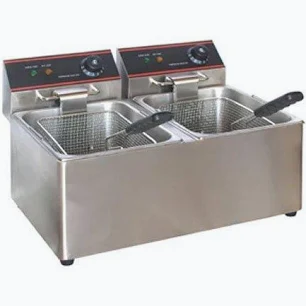
Number of tanks. Single-tank fryers have one oil bath. Double-tank fryers have two, which lets you fry chips in one and chicken, fish or samosas in the other, or run two batches of chips at once.
Basket size. Baskets limit how much you can lift out at one time. Many double-tank machines come with one basket per tank, while some larger fryers support two or three.
Heating power. Electric fryers are rated in kilowatts. For example, a typical 12-litre commercial electric unit sold in Kenya has a 3kW element. Gas fryers are rated by burner output. More power generally means faster heat-up and recovery.
Recovery time. This is how quickly the oil returns to frying temperature after you drop in a cold batch. For a chips business it matters even more than tank size, because chips are usually fried from a cold or frozen state.
Step 2: Estimate Your Peak-Hour Demand
Do not size your fryer for an average day. Size it for your busiest hour, because that is when you lose customers if you cannot keep up.
Start with a simple calculation:
- Estimate peak-hour orders. How many portions of chips do you expect to sell in your busiest hour? If you are new, look at a similar nearby business, or plan conservatively and leave room to grow.
- Decide your portion size. Many outlets use portions between about 200g and 400g of raw potato, depending on whether they sell small, regular or large servings.
- Calculate kilograms per hour. Multiply the number of portions by the portion weight.
- Work out batches per hour. Divide the kilograms per hour by the weight of one batch your fryer can handle (see the next step).
Example (illustrative only). Imagine you expect 60 portions of chips in your busiest hour, with each portion using about 300g of raw potato. That is 18kg of potatoes per hour. If your fryer can safely cook about 1.5kg in a batch and each batch takes around six minutes including loading and draining, you can complete roughly ten batches per hour, or about 15kg. In this case you would be slightly short at peak and should consider either a larger tank or a double-tank machine. These are sample figures, so use your own menu and timing.
Step 3: Know How Much Each Fryer Size Can Actually Cook
A common mistake is assuming a 12-litre fryer can cook 12 kilograms of chips. It cannot. Overloading the basket drops the oil temperature, makes chips greasy and can even cause oil to bubble over.
A widely used guideline is that the weight of food per batch should be a fraction of the weight of the oil, often around one-sixth to one-eighth. Because cooking oil weighs a little less than water, 12 litres of oil weighs roughly 11kg. That suggests a safe batch of about 1.4kg to 1.8kg of chips in a 12-litre tank. The exact figure depends on the fryer’s power, the thickness of the chips and whether the potatoes are fresh, blanched or frozen, so always check the manufacturer’s guidance for your model.
Use the following as a rough starting point for planning, not a guarantee:
| Fryer size | Typical use | Approximate chips per batch | Rough portions per hour* |
|---|---|---|---|
| 5 to 6 litres (single) | Home-based business, tiny kiosk, side station | Under 1kg | Roughly 15 to 30 |
| 8 to 12 litres (single or double) | Small shop, snack bar, small takeaway | About 1 to 2kg | Roughly 30 to 60 |
| 17 to 18 litres (single or double) | Busy takeaway, fast-food outlet, restaurant | About 2.5 to 3.5kg | Roughly 60 to 100 |
| 25 litres and above, or multi-tank | High-volume fast food, hotel, food court | 4kg and more | 100 or more |
*These ranges assume roughly 300g portions and continuous frying. They are planning estimates and will vary with your equipment and technique.
Step 4: Match Size to Your Business Type
Kiosk, street stall or start-up (5 to 8 litres). If you are testing your market or selling from a small stand, a compact fryer keeps your investment low. Be realistic about its limits. These machines are best for lower volumes, and you may need to fry in several short batches during busy periods.
Small takeaway or snack bar (10 to 12 litres). This is the sweet spot for many new Kenyan chips businesses. A 12-litre unit, or a double 12-litre fryer with two tanks, gives you enough capacity to handle lunch rushes while staying affordable. A double-tank machine is especially useful if you sell chips alongside chicken, sausages or samosas.
Busy fast-food outlet or restaurant (17 litres and up). Heavy, continuous frying calls for bigger tanks, stronger heating and faster recovery. Many suppliers list single 17 to 18-litre fryers for exactly this use, in both electric and gas versions.
Hotel, food court or multi-branch operation (25 litres and above). At this scale, consider floor-standing machines, multiple tanks or even more than one fryer. Having two fryers also gives you a backup if one needs servicing.
Step 5: Decide Between Gas and Electric
Fuel type affects which size is practical, so decide early.
- Electric fryers are generally cheaper to buy and easy to install, and they suit indoor kitchens with stable power. Larger models may need a stronger electrical supply, so confirm your wiring before you buy.
- Gas fryers usually heat up and recover quickly, keep working during power cuts and suit high-volume or mobile setups. They cost more upfront and need safe cylinder storage, good ventilation and regular leak checks.
For a small chips start-up with reliable power, electric is often the easier first step. For a high-volume outlet or an area with frequent outages, gas often makes more sense.
Commercial Chips Fryer Prices in Kenya: What to Expect
Price is the question most buyers ask first, so let us be clear: commercial chips fryer prices in Kenya vary widely depending on size, brand, build quality, fuel type and where you buy. The figures below come from online listings we reviewed, and they are indicative only. Prices change often, so confirm with the supplier before you commit.
| Fryer type | Typical size | Indicative price range (KSh) |
|---|---|---|
| Small electric single fryer | 3 to 6 litres | From roughly 3,500 to 15,000 |
| Electric double fryer | 2 x 6 or 2 x 12 litres | Listings seen from about 8,000 upward, with heavy-duty models costing more |
| Heavy-duty electric single fryer | 12 to 17 litres | Often in the tens of thousands, depending on brand and power |
| Gas single fryer | 18 litres | Listings seen around 48,000 |
| Floor-standing or multi-tank commercial fryers | 25 litres and above | Higher, often well above the figures above |
A few important points about these prices:
- Very low prices usually mean light-duty equipment. A fryer sold for a few thousand shillings may be designed for home or occasional use, not eight hours of daily frying.
- Gas models cost more upfront because of burners, valves and safety components, but may save money on running costs in busy outlets.
- Double-tank units often give you the best value for flexibility, since you can fry chips and other items at the same time.
- Installation and accessories add to the total. Budget for gas cylinders and regulators, electrical work, baskets, an oil filter, a chips cutter, a chips scoop station and a fire extinguisher.
When you compare commercial chips fryer prices in Kenya, look at the cost per litre of capacity and the cost over two or three years, not just the sticker price. A fryer that is a bit more expensive but lasts years, recovers quickly and is easy to repair is cheaper in the long run than one that fails in six months.
Step 6: Plan for Growth, but Do Not Overbuy
It is tempting to buy the biggest fryer you can afford. Resist that urge unless your sales justify it. An oversized fryer holds more oil than you need, and if you only fry small batches, the oil sits at temperature for long periods, degrades faster and costs more to replace.
A smarter approach is to size for your current peak demand plus a modest growth buffer, perhaps 20 to 30 per cent. If you are growing fast, choose a model that allows you to add a second fryer later, so you keep your first one as backup or for a second product.
Step 7: Check the Practical Details Before You Buy
Once you have settled on a size, check these practical points:
- Footprint and space. Measure your workspace, including clearance around the fryer for safe operation and cleaning.
- Power or gas supply. Confirm your electrical capacity or gas storage arrangements match the fryer’s needs.
- Build quality. Stainless steel construction, a sturdy basket handle, a reliable thermostat and a drain valve are signs of a commercial-grade machine.
- Safety features. Look for overheat protection and, on gas models, flame-failure protection.
- Oil management. Easy oil drainage and filtering protect your food quality and cut oil costs.
- Spare parts and after-sales support. Thermostats, elements and burners wear out, so buy from a supplier who stocks parts and can help.
Common Sizing Mistakes to Avoid
Choosing a commercial deep fryer based only on price or appearance can lead to costly mistakes. Avoid these common sizing errors when selecting a fryer for your chips business:
- Sizing for the average day instead of peak hour. You lose customers exactly when demand is highest.
- Overloading the basket. This lowers oil temperature and produces soggy, greasy chips.
- Buying on price alone. The cheapest listing may not survive commercial use.
- Ignoring recovery time. Tank size means little if the fryer cannot bounce back quickly between batches.
- Forgetting about workflow. Space for cutting, soaking, draining, salting and packing matters as much as the fryer itself.
Choosing the right commercial deep fryer size comes down to a few clear steps: estimate your peak-hour demand, understand how much each fryer can really cook, match capacity to your business type, choose between gas and electric, and compare commercial chips fryer prices in Kenya with long-term value in mind. Get this right and you will serve crisper chips, keep customers happy and protect your margins.
Buy Your Chips Fryer from Shine Kitchenware
Sizing a fryer is easier when you have an expert to guide you, and that is where Shine Kitchenware can help. Whether you are opening your first chips kiosk or expanding a busy fast-food kitchen, Shine Kitchenware can help you choose a commercial fryer that fits your volume, your space and your budget. Talk to the Shine Kitchenware team about your daily sales, menu and power or gas setup, and get advice on the right capacity before you spend your money.
Ask about available electric and gas fryers, current pricing, delivery and after-sales support so you know exactly what you are getting. Ready to compare commercial chips fryer prices in Kenya and find the right size for your business? Contact ShineKitchenware.co.ke today and get equipped to serve hot, crispy chips that keep customers coming back.
 No products in the cart.